
The Future of Smart Lighting Control: How AI Could Change Lutron, Control4 and Crestron Homes
Artificial intelligence is going to change the smart home.
But perhaps not in the way people initially imagine.
We don't believe AI will remove the need for professional lighting designers, engineers or installers. What it should do is remove a significant amount of repetitive engineering and programming work, give homeowners far greater control over how their homes behave, and potentially make professionally designed smart lighting control accessible to more people.
For companies such as ours, that isn't something to resist.
It could allow us to spend less time producing documentation and making minor programming changes, and more time doing the things where experience genuinely matters: designing, engineering, installing and commissioning better systems.
And lighting is probably one of the most interesting places to see that change happen.
A large part of lighting design currently happens before anything is installed
When somebody sees a finished Lutron keypad on a wall, they are seeing perhaps one percent of the work behind it.
A properly designed lighting-control system starts much earlier.
There are architectural drawings to review, circuits to identify, lighting loads to calculate, fittings and drivers to specify, keypad positions to coordinate, lighting schedules to produce, drawings to revise and information to exchange with architects, electricians, interior designers and other trades.
For a typical smart-home project, we can easily spend around 60 hours producing the design and engineering package before and during installation.
Some of that requires considerable experience.
Some of it does not.
Creating schedules, transferring information between drawings, calculating loads, generating documentation and checking specifications are precisely the types of structured tasks where we believe AI-assisted design software will make a major difference.
Our expectation is that, over time, the administrative and engineering time involved in a typical residential lighting-control design could potentially be reduced by around 50%.
That doesn't mean asking AI to design the house.
It means giving an experienced designer significantly better tools.
That could actually improve the lighting
Reducing design time shouldn't simply mean making projects cheaper.
There is another possibility.
If less of a client's budget is being spent producing repetitive documentation, more of that budget can potentially go into the parts of the lighting scheme that they actually experience every day.
Better fittings.
Better optics.
Better colour rendering.
Better LED drivers.
Better dimming.
And more time spent testing and commissioning the result.
That distinction matters because good lighting isn't simply a mathematical exercise.
A room can meet every lighting calculation and still look terrible
One of the mistakes we regularly see is designing purely around light levels.
The calculation says the room requires a particular number of lumens, so more fittings are added until that number has been achieved.
Technically, the calculation works.
Visually, the room can be ruined.
Good residential lighting is about layers, contrast and restraint.
A space may contain architectural lighting, decorative fittings, joinery lighting, task lighting, wall washing and accent lighting. Those elements work together differently throughout the day.
The same room might need to feel bright and functional at 8am and intimate at 8pm.
Simply filling the ceiling with downlights doesn't create that.
This is where experience still matters
We have spent hundreds of projects and thousands of hours testing what different fittings actually do once they are installed within real buildings.
A datasheet can tell you the lumen output and beam angle.
What it cannot fully communicate is how that fitting will interact with a particular stone wall, piece of joinery, ceiling height, artwork or interior finish.
A designer gradually develops a visual library from experience.
You understand when a fitting will work.
You also understand when not to add another fitting.
AI will become extremely good at processing specification data.
That is different from experiencing a room.

Where AI could transform professional lighting design
This is where the technology becomes particularly useful.
Imagine uploading the architectural plans for a property alongside the lighting specification.
An AI-assisted design platform could potentially identify all of the lighting circuits, interpret the fixture schedule, calculate connected loads, highlight potential driver compatibility issues and start building the lighting-control documentation.
The designer then reviews it.
Instead of spending hours transferring information between drawings and spreadsheets, they're concentrating on decisions.
Should this fixture be here?
Is the beam angle correct?
Do we need another lighting layer?
Should these circuits be grouped differently?
How should the room behave at night?
That is a much better use of an experienced designer's time.
Client visualisation will probably change too.
Rather than asking a homeowner to interpret a technical lighting drawing, increasingly sophisticated visualisation tools could allow them to experience different lighting concepts before the electrical installation begins.
The AI isn't replacing the designer.
It's shortening the distance between the designer's idea and the client's understanding.
Our York Penthouse smart lighting project is a good example of why that human interpretation still matters. The project involved translating a carefully considered lighting design into a whole-home control system while protecting the architectural and interior-design intent.
AI-assisted Lutron programming could be particularly interesting
Lutron HomeWorks is a good example because there is already a clear distinction between the engineering underneath the system and the scenes the homeowner experiences.
The underlying system is professionally designed and commissioned.
The homeowner experiences something much simpler.
A button might say:
Dining
Relax
Entertain
All Off
Behind that single button can be multiple lighting circuits operating at different levels.
This is where we think AI-assisted Lutron programming could become particularly useful.
Protect the engineering.
Make the experience considerably easier for the homeowner to modify.
A homeowner shouldn't need to understand lighting programming simply because they decide they want their dining scene slightly darker.
And increasingly, it feels outdated for them to have to book an engineer for every lifestyle-related adjustment.
Instead of programming a scene, describe what you want
Imagine saying:
“When we're having dinner, soften the kitchen lighting, bring the pendant down slightly, switch on the joinery lighting and close the blinds after sunset.”
The AI could interpret the intent and create or modify a permitted scene.
Or:
“The kids are having friends over tonight. Make the games room brighter than normal until 10pm.”
Again, the homeowner hasn't programmed anything.
They've described an outcome.
That is fundamentally different from a conventional smart-home interface.
And that doesn't remove the need for a professionally designed system underneath it.
It simply makes that system more useful to the person who owns it.
Control4 and Crestron could make the idea much bigger than lighting
This is where the conversation moves beyond Lutron.
Lutron may be controlling the lights and blinds, but platforms such as Control4 or Crestron Home can sit across the wider property.
Lighting.
AV.
Heating.
Blinds.
Security.
Music.
Televisions.
Home cinema.
That creates the possibility of moving from a command-based smart home towards an intent-based smart home.
Today you might press:
Film Night.
Tomorrow you might simply say:
“We're going to watch a film.”
The house understands what that means.
The blinds close.
The lights change.
The television or projector starts.
The heating adjusts.
The unnecessary downstairs lighting switches off.
And, over time, the system could potentially learn that your family prefers the room slightly brighter when watching sport than when watching a film.
The technology begins adapting to the people rather than asking the people to adapt to the technology.
That is where AI and professional home automation become genuinely interesting.
But somebody still has to build the house underneath the AI
This is where the conversation around artificial intelligence can become misleading.
A smart home is not software floating in the cloud.
It exists inside a physical building.
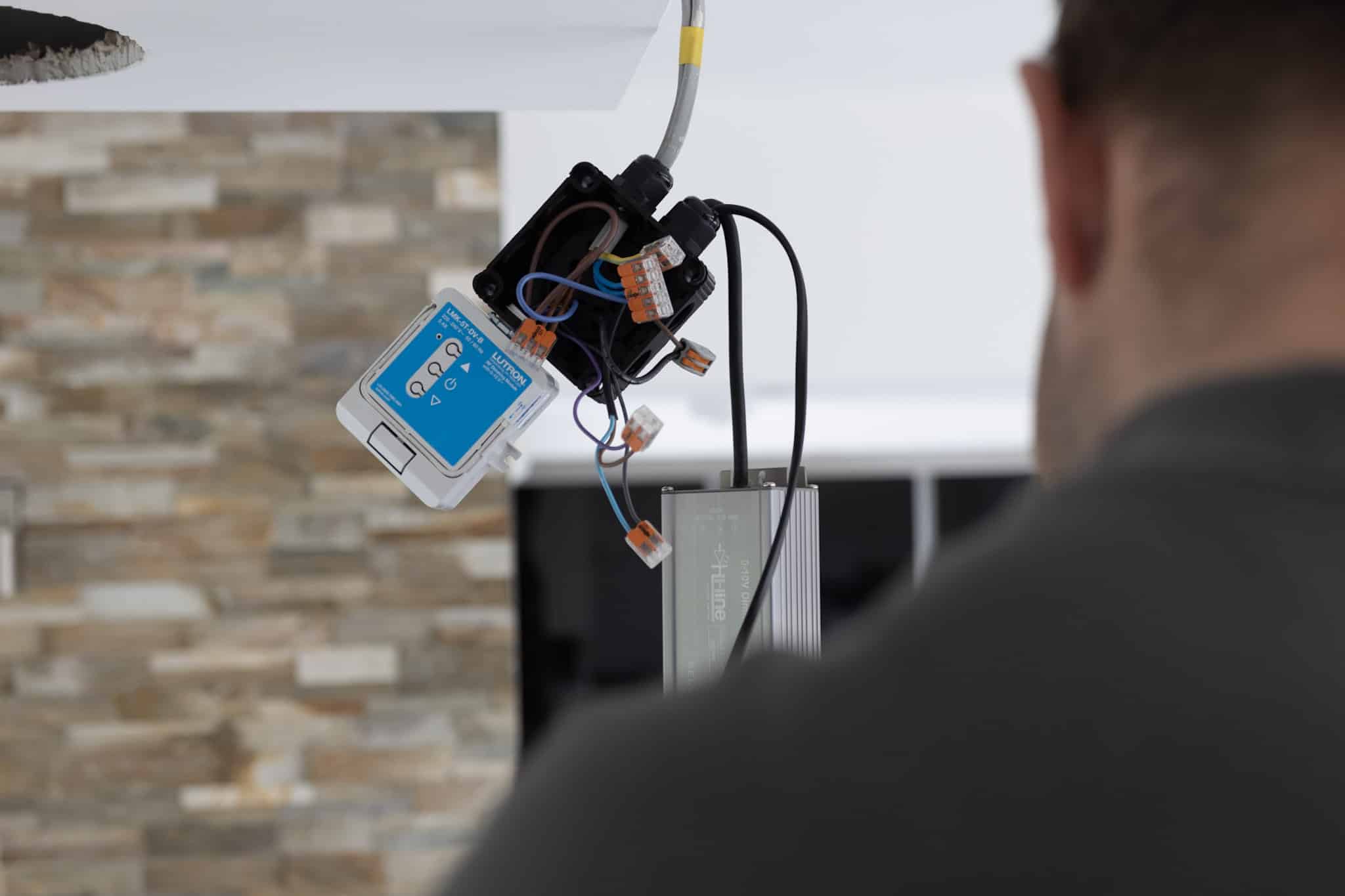
Behind that voice command are cables, lighting circuits, control processors, dimming modules, LED drivers, power supplies, networks, keypads and electrical infrastructure.

AI cannot make a poor-quality LED driver dim smoothly.
It cannot correct an incorrectly positioned fitting after the ceiling has been finished.
It cannot compensate for bad wiring.
It cannot change the optical performance of an inappropriate fixture.
And it cannot physically install a lighting-control panel.
The easier the software becomes, the more important it may become to understand what is happening underneath it.
Engineering should remain protected
Giving the homeowner more control does not mean handing artificial intelligence unrestricted access to the fundamental engineering of the building.
There should be a clear boundary.
A future homeowner-controlled AI system might be allowed to change:
- scenes
- timings
- preferred light levels
- everyday automations
- room behaviour
- how lighting interacts with blinds, AV and other systems
But core engineering settings such as electrical protection, maximum loads, driver configuration and the underlying system architecture should remain separate.
That isn't because AI will never be capable of calculating those things.
It is because those decisions form part of the engineered system that somebody ultimately has responsibility for designing, installing and signing off.
The AI layer should operate on top of good engineering, not continuously rewrite it.
AI could also change how smart lighting systems are serviced
This is another area we find particularly interesting.
Many failures within a lighting-control installation are not failures of the central intelligence.
Components age.
Power supplies deteriorate.
LED drivers eventually need replacing.
Historically, the first indication is often that something stops working.
A genuinely intelligent home should eventually be able to do better than that.
Imagine your assistant saying:
“The power supplies serving the basement lighting are approaching their recommended service interval. Would you like me to contact your smart-home contractor and arrange a visit around your diary?”
The assistant could then supply the integrator with relevant system information before the engineer even arrives.
That isn't something we're claiming today's Lutron, Control4 or Crestron systems currently provide natively.
It's where we believe connected monitoring, system data and AI could logically take professional smart-home maintenance.
And it would turn maintenance from something reactive into something increasingly preventative.
So what happens to the smart-home programmer?
We think the role changes.
And probably for the better.
There will still be programming.
There will still be commissioning.
There will still be highly complex projects requiring experienced people who understand the underlying platforms.
But charging a homeowner to make every small scene adjustment isn't where the industry's greatest value lies.
The value is increasingly going to sit in:
design, engineering, installation, commissioning, integration and long-term support.
Platforms such as Control4 already demonstrate that professional installation and homeowner personalisation don't have to be mutually exclusive.
AI should allow that principle to go considerably further.
Better tools could make professional lighting accessible to more homes
This may ultimately be one of the most positive outcomes.
Professional lighting design and control is sometimes perceived as something reserved for extremely large projects.
Part of the reason is simply the amount of professional time required to produce it.
If AI can reduce the hours spent on drawings, schedules, load calculations, specifications and repetitive programming, sophisticated lighting design potentially becomes viable on more projects.
And instead of reducing quality, the technology could allow more of the homeowner's budget to be invested in better quality fittings, drivers and engineering.
That's the version of AI we're interested in.
Not replacing the expert.
Giving the expert leverage.
The best smart home is still one you don't have to think about
For all the technology involved, the objective hasn't really changed.
You shouldn't have to think about the smart home.
You should think about your home.
The lighting should feel right.
The blinds should be where you want them.
The room should respond naturally.
And if you decide six months later that you want the dining room to behave differently, you shouldn't need to understand a programming language to change it.
AI may eventually give homeowners much more of that freedom.
But underneath that intelligence still needs to sit something considerably less glamorous:
good design, good engineering and good installation.
That's the foundation that allows all the clever stuff to work.
And we don't see AI replacing it.
We see AI allowing us to spend more time doing it properly.
Planning a smart lighting or home-automation project?
Inspire Audio Visual designs, installs and supports professional lighting-control systems and smart-home technology across Yorkshire, Cheshire and London.
We work with platforms including Lutron, Control4 and Crestron, allowing us to design the lighting and control system around the property rather than forcing every project onto one platform.
If you're planning a renovation, new build or significant smart-home upgrade, bringing the lighting and control design into the project early normally gives us considerably more freedom to get the finished result right.