Why Inspire AV Supports CDLF, a Yorkshire Charity

More Than Business: Why We're Supporting the Charlie Dallas Lancaster Foundation

At Inspire Audio Visual, most of our working days revolve around technology. We're designing smart homes, installing cinemas, working alongside interior designers and helping people get the best from their homes.

But every so often, something comes along that feels a little more important than the day job.

Over the past couple of years, we've become increasingly involved with the Charlie Dallas Lancaster Foundation (CDLF), a Yorkshire charity dedicated to raising awareness of mental health and helping people find the support they need.

What began with helping a friend at a fundraising event has grown into something much bigger, both personally and as a business.

And it's a relationship we're proud to be part of.

Where it all started

Our involvement with CDLF began in early 2025 through a good friend of mine, Mark Karvounis.

Mark and I have trained together for a number of years, and he had previously received support through the foundation. Wanting to give something back, he decided to take on a fairly ridiculous challenge: rowing 41 miles.

Not 41 kilometres. Forty-one miles.

On 31 May 2025, Mark put himself through an extraordinary physical challenge, raising £7,296 for CDLF in the process.

A small group of friends came together to support him, and Inspire helped on the day, including providing some of the audiovisual equipment needed for the event.

It was our first experience of fundraising for the foundation, but it certainly wasn't going to be the last.

What stood out wasn't just the physical achievement. It was seeing a community of friends, businesses and supporters come together around something that genuinely mattered.

And for me, the charity's purpose struck a particularly personal chord.

Why mental health support means so much to me

This is something I've become more comfortable talking about as I've got older.

When I was younger, I struggled with my own mental health. I was fortunate enough to have access to a therapist, and that experience genuinely changed the direction of my life.

It helped me understand myself, challenged the way I looked at things and ultimately played a significant part in shaping the person I am today.

I don't think it's an exaggeration to say that having that support when I needed it changed my outlook on life.

It's one of the reasons I feel so strongly about what CDLF is trying to achieve.

Getting help shouldn't depend on whether somebody can afford private therapy or how long they're prepared to sit on a waiting list.

When somebody finally finds the courage to say they're struggling, that moment matters.

The sooner they're able to access meaningful support, the better.

CDLF works to raise awareness, connect people with support services and fund organisations and initiatives that make a difference to mental health across Yorkshire.

I know first-hand how valuable that kind of help can be.

And if I can use my time, our business or the people around me to help make that support more accessible, then it's something I want to keep doing.

From one challenge to the next

Following Mark's rowing challenge, I started thinking about what I could do myself.

That eventually became a 500km journey from York to Brighton in 2025, combining cycling and running to raise money for CDLF and Together for Cinema, another charity close to our industry.

It was a considerable step up from helping with somebody else's fundraiser.

And in July 2026, things went a stage further when six of us took on a non-stop 500km relay from Scotland to Thirsk, raising more than £34,000 for CDLF.

Both challenges were part of what has become The Hard Mile, a group of friends using physical challenges to raise money and awareness for causes we believe in.

You can read more about our York to Brighton challenge and the Scotland to Thirsk relay in their own articles.

But fundraising challenges are only one part of how we've been able to help.

Using what we do every day to make a difference

One of the advantages of running a business is having access to skills, equipment and relationships that might be useful outside your normal working environment.

For Inspire, that's often audiovisual technology.

At a recent CDLF event, we supplied large screens to show the foundation's video, helping explain the charity's work and what it's trying to achieve to the people attending.

It might sound like a relatively small contribution, especially compared with the effort that goes into organising these events.

But helping a charity communicate its message effectively is important.

If somebody leaves an event understanding more about CDLF, decides to support the foundation or shares its message with somebody who needs help, then that visibility has value.

Hannah and I have enjoyed being involved in supporting these occasions, and it's encouraged us to think about what else we could contribute.

Which brings us to the next project.

Helping CDLF build a better website

We've recently been appointed to project-manage the redevelopment of the Charlie Dallas Lancaster Foundation website.

It's a slightly different kind of project for Inspire, but one that makes a lot of sense to us.

The original website served an important purpose. It gave the foundation an online presence, somewhere people could learn about the charity and see that it was established and doing meaningful work.

But we believe the website can do considerably more.

It should help people discover CDLF in the first place, clearly explain the support available, make it easier for individuals to find appropriate help and encourage businesses and supporters to get involved.

That's as much about the structure, content and search engine visibility as it is about making the website look good.

Our role is to coordinate the wider project, from design direction and development through to content strategy, SEO and making sure the finished website delivers what the charity actually needs.

The initial design direction has been approved, and we're now working towards implementation.

For me, the goal is straightforward.

If somebody in York or the surrounding area is searching for mental health support, information about the foundation or a way to contribute to its work, the website should make that journey as easy as possible.

A charity can do extraordinary work, but people still need to be able to find it.

More than a logo on a sponsorship board

We're not a huge national company with an enormous charitable budget.

We're a Yorkshire business, with a team of people who care about the places and communities around us.

Sometimes that means supplying equipment for an event. Sometimes it's spending months preparing for a fundraising challenge. And sometimes it's putting our professional experience to work on a website that could help somebody find support.

We don't see those as particularly separate things.

They're simply different ways of contributing.

Our involvement with CDLF started because a friend decided to row 41 miles for a cause that had helped him.

It's since become something I care about deeply, and something Hannah and I hope to continue supporting for years to come.

If you'd like to learn more about the foundation, support its fundraising or understand the work it does, please visit the Charlie Dallas Lancaster Foundation website.

And if you're a local business wondering whether you could help, you probably have more to offer than you think.

Sometimes the most useful thing you can give is simply what you're already good at.
How Inspire Audio Visual Started – The Ben Davies Story


Why I Built Inspire Audio Visual

By Ben Davies, Founder & Director of Inspire Audio Visual

Inspire Audio Visual started in 2009.

At the time, I probably didn’t have some perfectly polished vision of what the company would look like nearly two decades later. What I did have was a very clear idea of how I thought clients should be looked after.

I wanted to build a company around good advice, good engineering and doing things properly.

That sounds simple.

In reality, it has shaped almost every decision we’ve made since.

It was never really about selling technology

I’ve always loved technology, audio, cinema and the possibilities of a genuinely well-designed smart home.

But the longer I’ve worked in this industry, the more I’ve realised that the technology itself is only part of the job.

Clients don’t really want a rack full of equipment.

They want to walk into a room and press one button.

They want the lighting to feel right.

They want the music to play.

They want the television to work.

They want the Wi-Fi to be reliable.

They want their blinds, heating, security and entertainment to work together without having to understand what is happening behind the scenes.

And perhaps most importantly, they want somebody they trust at the other end of the phone when something isn’t right.

That philosophy has become increasingly important to me as Inspire has grown.

Complex technology should create a simpler home, not a more complicated one.

Growing without losing what mattered

Over the years, Inspire has changed considerably.

We’ve worked on everything from individual media rooms and home cinemas through to large whole-house systems incorporating lighting, audio, video, networking, CCTV, access control, heating, blinds and automation.

Projects have taken us throughout Yorkshire, Cheshire, London and across the UK, with systems ranging from relatively simple installations through to homes containing hundreds of thousands of pounds of technology.

We’ve been fortunate enough to work in some incredible properties.

But strangely, those aren’t necessarily the things I remember most.

I remember the families.

I remember clients inviting us back years later.

I remember working on one part of somebody's house and then being trusted to do the next one.

I remember children growing up in homes we've worked in.

And I remember recommendations from one client turning into relationships with another.

For me, that has always been a better measure of the business than simply how many projects we complete.

The client comes first — even when nobody sees our name

One of the things that probably says quite a lot about Inspire is that, for a period, we actually removed the branding from our vans.

We were working for some relatively well-known clients who understandably didn't want people knowing what work was being carried out inside their homes.

They asked whether we could arrive in unbranded vehicles.

So we did.

From a marketing perspective, having blank vans driving around the country probably wasn't the greatest strategy.

But it was right for the client.

And that's always been the test.

Even today, there are projects we're incredibly proud of that will never appear on Instagram, never become a case study and never be photographed.

If a client wants complete discretion, that's what they get.

Their home isn't our marketing material.

Doing things properly

As the company developed, another principle became increasingly important to me:

If we don't believe something is right for the project, we should be prepared to say so.

There is always another piece of technology you can sell.

Another upgrade.

Another feature.

Another box.

But more isn't automatically better.

The best systems are normally the ones where somebody has taken the time to understand how the family actually lives.

Who uses the house?

What happens when they wake up?

How do they entertain?

Where do they listen to music?

What happens in the evening?

Do they want visible technology, or should virtually everything disappear into the architecture?

Only then should you start deciding what equipment belongs in the building.

That's also why we've increasingly become involved earlier in projects.

Good smart-home design starts long before somebody asks where the television is going.

It involves architects, interior designers, lighting designers, electricians, developers and the client all understanding what the finished house is meant to feel like.

Get those decisions right early and the technology almost disappears.

Get them wrong and you're forever trying to engineer around compromises.

The industry has changed dramatically

When Inspire began in 2009, the smart-home market looked very different.

Technology has improved enormously.

Networks have become fundamental to almost everything inside the home.

Streaming has transformed how we consume music and film.

Lighting control has moved far beyond simple dimming.

Security, access control, environmental systems, voice control and automation have become increasingly connected.

And now AI is beginning to change the way systems are designed, programmed and eventually how people will interact with their homes.

But there is an interesting contradiction.

As the technology becomes more sophisticated, I believe the client's experience should become simpler.

The engineering behind a modern home can be incredibly complex.

The homeowner shouldn't have to know that.

They should simply know that it works.

What we've learned from working in people's homes

Working in someone's home is different from working in almost any other environment.

You're entering somebody's private space.

Sometimes you're there during a major construction project.

Sometimes the family is already living there.

Sometimes you're fixing a system installed by somebody else.

Sometimes you're involved with a home for many years.

That brings a responsibility that goes beyond installation.

You have to respect the property.

You have to respect privacy.

You have to communicate properly.

And when something goes wrong — because occasionally technology does go wrong — you have to take ownership of it.

I think clients remember how a company behaves when there's a problem far more than they remember how it behaves when everything is easy.

That has certainly influenced how I run Inspire.

Building the right team

Another thing I've learned is that no founder builds a company alone.

As Inspire has grown, one of the things I'm proudest of is the knowledge within our team.

Design, programming, engineering, project management and installation are all different disciplines.

Great projects happen when those people work together.

My role has changed considerably because of that.

In the early days you're involved in virtually everything.

As the business grows, part of the challenge is allowing people who are better than you at certain things to take ownership of them.

That's healthy.

The objective shouldn't be to build a company that revolves around its founder.

It should be to build a company where the standards and philosophy survive regardless of who happens to be on site that day.

I'm still obsessed with the details

That doesn't mean I've stopped being involved.

Quite the opposite.

I can still disappear down a rabbit hole discussing a lighting detail, speaker position, cinema design, control interface or some new piece of technology that might solve a problem we've been wrestling with.

I'm genuinely fascinated by where the industry is going.

But experience has changed the question I ask.

Years ago, it might have been:

"What can this technology do?"

Today it's much more likely to be:

"Does this actually make the client's home better?"

There's a big difference.

What Inspire means to me today

Nearly two decades after starting Inspire, the business is considerably larger and the projects are considerably more sophisticated.

But the core idea hasn't really changed.

Do good work.

Be straightforward with people.

Design systems properly.

Look after the client.

And build something you'd be happy putting into your own home.

We're not interested in installing technology simply for the sake of it.

The aim is to create homes that are easier to live in, enjoyable to spend time in and technically capable without feeling technical.

Sometimes that means a dedicated home cinema with an enormous screen and immersive audio.

Sometimes it's beautifully designed architectural lighting.

Sometimes it's whole-house automation.

And sometimes it's simply making sure the Wi-Fi works everywhere.

All of those things matter if they matter to the person living there.

What's next?

I'm probably more interested in the future of our industry now than I've ever been.

AI, intelligent lighting, energy management, presence detection and increasingly contextual automation will change what we think of as a "smart home".

I think we're moving away from homes that simply respond to commands towards homes that better understand what is happening around them.

But my view of the technology remains the same.

The cleverest system isn't necessarily the one with the most automation.

It's the one that feels completely natural to the person using it.

That's what we're continuing to work towards at Inspire.

Technology that can be enormously sophisticated behind the scenes...

and wonderfully simple in front of the client.

— Ben Davies
Founder & Director
Inspire Audio Visual Ltd

Smart Home Installation Harrogate | Inspire AV on the Road

Why You Might Start Seeing More of Inspire AV Around Harrogate

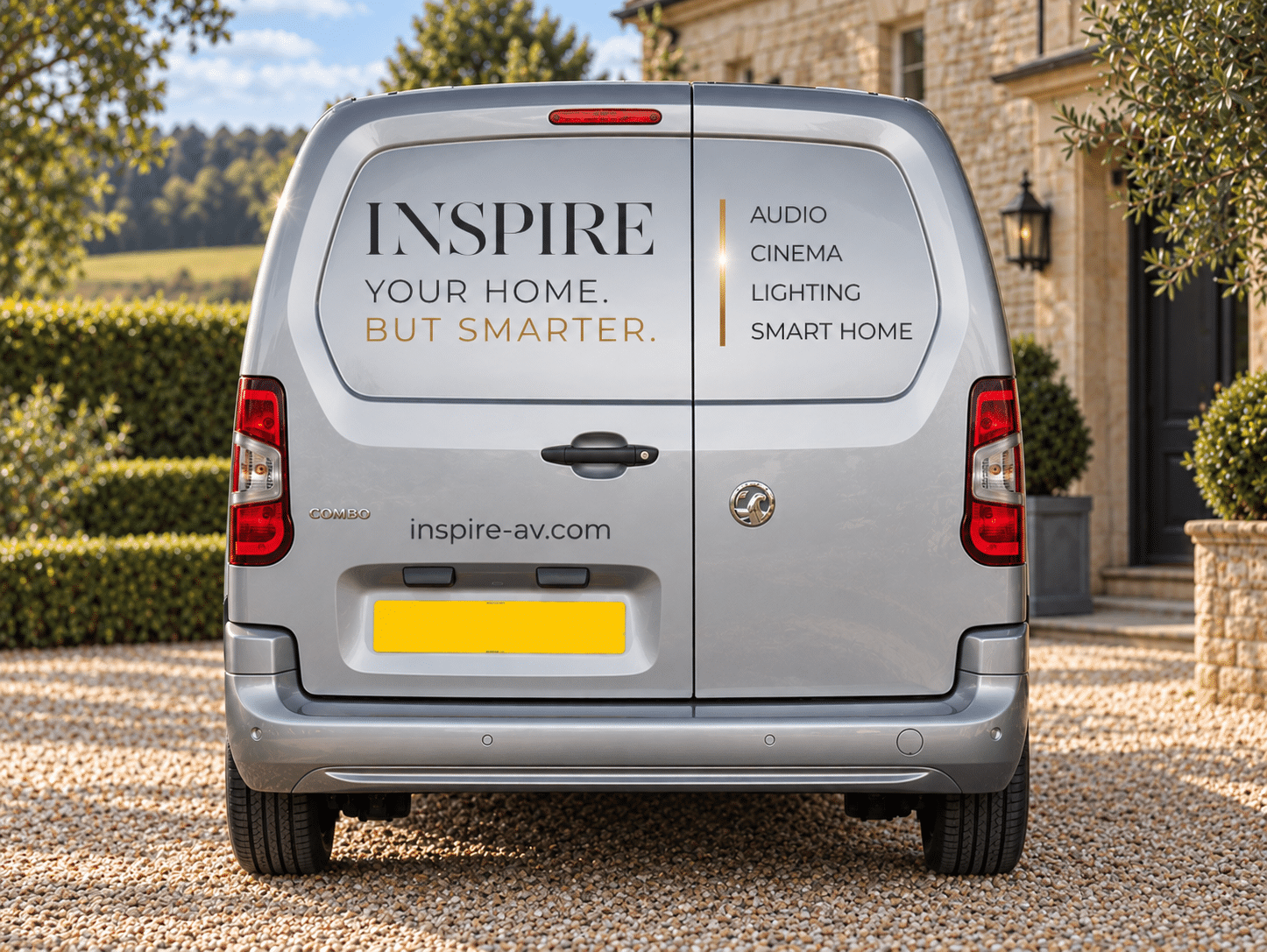
If you’re around Harrogate and North Yorkshire, you may start seeing the Inspire AV name on the road a little more often.

For years, most of our vans have actually been left unbranded — and there was a good reason for it.

In the earlier days of Inspire, our vehicles were fully branded. But as we started working on more high-end homes, including projects for some well-known clients, we were occasionally asked to arrive in unbranded vehicles.

For some clients, it was simply about privacy. For others, there were genuine security considerations, or they just preferred that the work happening inside their home remained exactly that — private.

And because Inspire has always been a client-first business, we listened.

Bringing the Inspire AV Brand Back to the Road

Fast-forward to today and, being completely honest, we want more people to know who Inspire AV is.

We’re designing and installing smart homes, home cinemas, lighting systems, networking and integrated technology across Harrogate, Yorkshire, Cheshire and London, and it makes sense for our brand to be visible while we’re out doing it.

But we didn’t want that to come at the expense of something our clients value.

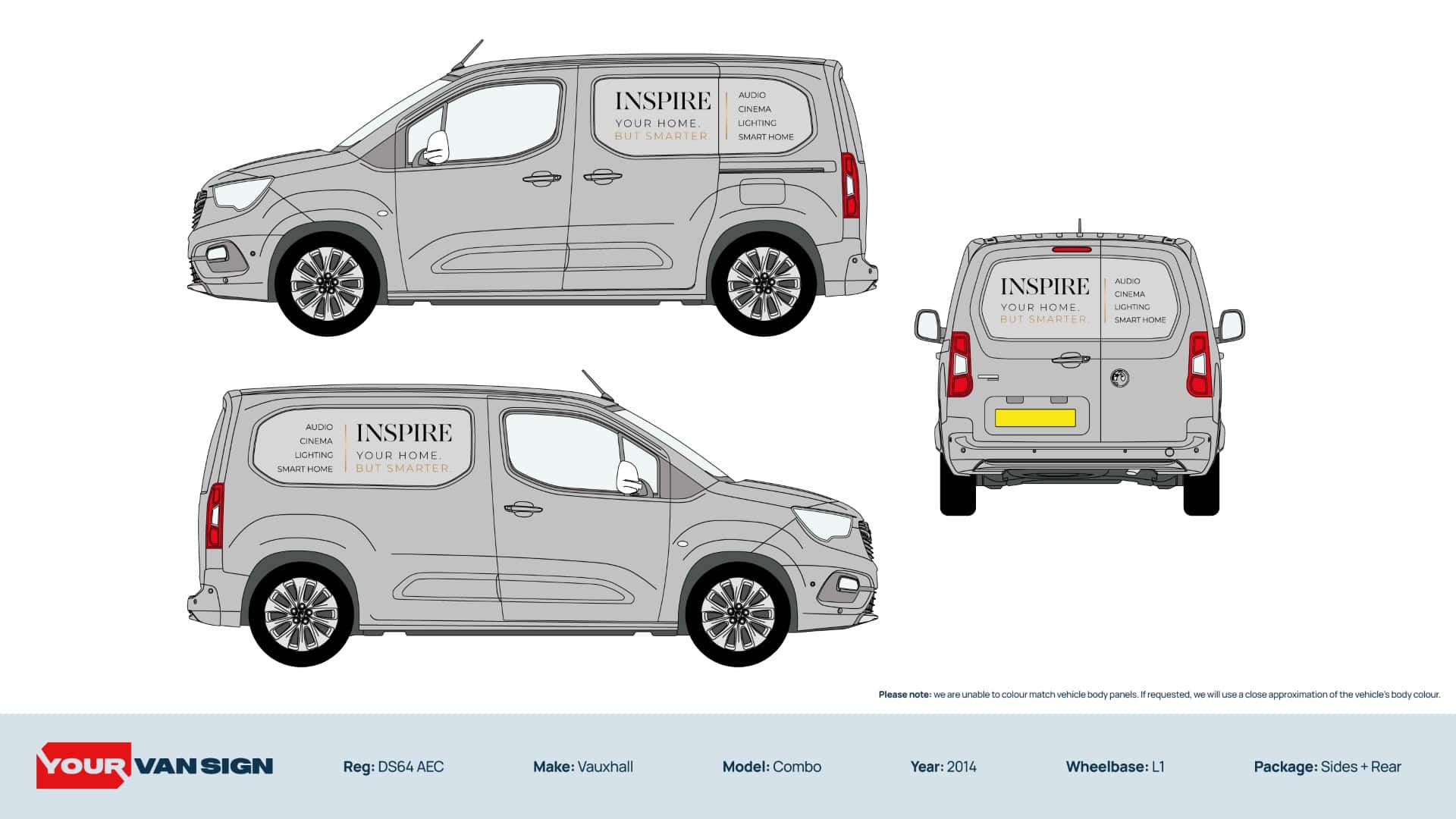
So rather than permanently wrapping the vans, we’ve had removable magnetic Inspire AV signage made.

Simple idea really.

When it’s appropriate, the branding is on.

When a client would prefer additional privacy or discretion, it comes off.

The same principle applies to our social media and project photography. We love showing the work we do, but ultimately the home belongs to the client, not our marketing department.

Smart Home Installation in Harrogate

Inspire AV has been designing and installing residential technology since 2009, working on everything from individual rooms through to complete smart home systems.

For homeowners, architects, interior designers and developers in Harrogate and the surrounding area, our work can include:

  • Control4 smart home automation

  • Intelligent lighting and lighting control

  • Home cinema and media rooms

  • Multi-room audio and television

  • High-performance home Wi-Fi and networking

  • CCTV, intercom and security integration

  • Automated blinds and curtains

  • Heating and climate control

  • Outdoor audio and entertainment

Our approach is to make technology feel like part of the home rather than something that has simply been added to it.

Good smart home design should make a house easier to live in, not more complicated.

So if you see one of the new Inspire AV vans around Harrogate, give us a wave.

And if you don’t see the branding one day, there might be a reason for that too.

Planning a smart home project in Harrogate or North Yorkshire?

Find out more about our smart home installation services in Harrogate or speak to the Inspire AV team about your project.

AI & Smart Lighting Control: Lutron, Control4 & Crestron

The Future of Smart Lighting Control: How AI Could Change Lutron, Control4 and Crestron Homes

Smart lighting control has transformed how we experience our homes. But could artificial intelligence take things a step further, making our lighting more intuitive, more efficient and more personal?

For nearly two decades, we've been designing and installing smart home systems at Inspire Audio Visual. During that time, lighting control has evolved considerably. We've moved from banks of conventional switches to beautifully designed keypads, automated scenes and systems capable of integrating lighting with blinds, heating, security and entertainment.

Yet fundamentally, most lighting systems still rely on one thing: somebody telling them what to do.

You press a button, select a scene or rely on a pre-programmed schedule. The system responds exactly as it has been instructed.

Artificial intelligence could change that relationship.

Instead of simply responding to commands, the next generation of smart lighting control might begin to understand how we live, predict what we need and adapt our surroundings without constant intervention.

But is that genuinely useful innovation, or are we in danger of making something simple unnecessarily complicated?

Smart Lighting Control Today: Already Pretty Clever

Modern lighting control systems from manufacturers such as Lutron, Control4 and Crestron are already remarkably capable.

We can programme a single keypad button to transform an entire living space. Lighting levels adjust, curtains close, music starts playing and a room changes from a practical family environment into somewhere designed for entertaining.

Astronomical time clocks can adjust exterior lighting around sunset and sunrise. Presence sensors can automate corridors and bathrooms. Scheduled scenes can gradually change lighting throughout the day.

In projects such as our York Penthouse Smart Lighting installation, the objective is to bring sophisticated technology into a carefully considered interior without making it complicated to use.

For homeowners, that simplicity matters far more than the technical complexity behind the scenes.

But even the best programmed lighting system has limitations.

A lighting designer or programmer makes decisions about how the home should behave based on what they know at the time of installation. As the homeowner's routines change, those decisions might need adjusting.

This is where AI becomes interesting.

What Could AI Actually Bring to Smart Lighting?

Imagine a home that understands the difference between somebody getting up early for work, a relaxed Sunday morning and an evening entertaining friends.

Rather than relying entirely on fixed schedules, an intelligent lighting system could learn patterns of behaviour and suggest or automatically make appropriate adjustments.

It might notice that the kitchen is normally occupied earlier during the week, that the family prefers warmer lighting in the evenings or that particular rooms are rarely used at certain times.

Combined with occupancy information, daylight levels and other sensors, AI could help the lighting respond more naturally to the way the property is actually being used.

Of course, much of this can already be achieved using conventional programming. The difference would be the system's ability to adapt rather than requiring an engineer to modify every rule.

The technology would also need sensible boundaries. A homeowner should always be able to override the automation, and the system must remain predictable.

Nobody wants their kitchen lights making unexpected decisions because an algorithm thinks it knows better.

The Real Opportunity: Better Lighting Design

For me, one of the most interesting applications of AI isn't necessarily how a finished smart home operates.

It's how we design it in the first place.

A properly considered lighting design involves far more than deciding where to put downlights.

We need to understand the architecture, natural daylight, furniture layouts, decorative fittings, colour temperatures, circuit arrangements and the way different spaces will be used.

Then there are the technical drawings, load schedules, dimming requirements, keypad locations, scene programming and coordination with electricians, architects and interior designers.

On a typical substantial residential project, we might spend around 60 hours on the design and associated planning work.

Could AI reduce that by 50%?

I think there's a realistic opportunity for it to do so in parts of the process.

AI-assisted software could potentially analyse architectural drawings, help identify circuit arrangements, produce draft schedules and accelerate repetitive documentation.

That could give designers more time to concentrate on the areas where their experience genuinely adds value.

But there's an important distinction between producing a lighting plan and designing beautiful lighting.

AI might identify where a fitting could go. It doesn't necessarily understand why a particular architectural feature deserves emphasis, how light will interact with a textured wall or the emotional effect of a carefully balanced scene.

Those decisions still benefit enormously from human experience.

Will AI Replace Lighting Designers and Programmers?

I don't believe so, although I do think the roles will change.

Much of what makes a successful lighting installation comes from understanding the homeowner rather than simply understanding the equipment.

A family with young children will use its home differently from a couple who regularly entertain. Somebody who works unusual hours might need very different lighting behaviour from someone following a conventional routine.

A well-designed system accounts for those differences.

Our job isn't to install as much technology as possible. It's to understand the people who will live with it and then use the technology appropriately.

AI could become an extremely powerful design assistant. It might make documentation faster, identify potential issues earlier and help us explore different approaches before installation begins.

But it shouldn't replace the conversations, judgement and experience that make a home feel right.

In many respects, I'd welcome technology that takes repetitive engineering administration away from our designers.

The more time we can spend thinking about the finished experience, the better.

What Does This Mean for Lutron, Control4 and Crestron?

Manufacturers such as Lutron, Control4 and Crestron have spent years developing reliable, sophisticated control platforms.

The interesting question is how AI might complement these systems.

I don't necessarily see the future as replacing established lighting control infrastructure with an entirely new generation of AI-powered devices.

A properly engineered lighting system still needs dependable dimming, suitable wiring, reliable communication and physical controls that work every time.

Instead, I suspect much of the intelligence could eventually sit above the existing infrastructure.

AI could potentially analyse how lighting scenes are used, recommend improvements, adapt schedules and help commissioning engineers refine system behaviour.

It might even allow homeowners to describe a desired atmosphere in natural language and have the system suggest an appropriate lighting scene.

That said, these are possibilities rather than features we can assume are currently available across the manufacturers' residential systems.

And reliability must remain the priority.

If your internet connection fails, you should still be able to turn your lights on.

The Homeowner Shouldn't Have to Think About the Technology

One concern I have with the smart home industry is our tendency to become fascinated by what technology can do rather than asking whether the homeowner needs it.

We've seen this with touchscreens, complicated interfaces and systems that offer hundreds of functions when most people only use a handful.

AI could easily become another example.

A homeowner doesn't necessarily want a conversation with their house every time they enter the kitchen.

They want the lighting to feel right.

Sometimes the most intelligent solution is still a beautifully designed keypad with three or four clearly labelled buttons.

The challenge for manufacturers and installers will be introducing greater intelligence without compromising the simplicity that makes a system enjoyable to live with.

In my view, the best smart home technology is the technology you barely notice.

Could AI Make Smart Lighting More Affordable?

If AI reduces the time required for some design, documentation and programming tasks, there could eventually be a financial benefit for homeowners.

On larger projects, engineering and design time represents a meaningful proportion of the overall cost.

Reducing repetitive work could improve efficiency and allow installers to spend more time refining the finished installation.

But that doesn't mean lighting design should become a fully automated, low-cost commodity.

A poorly designed lighting scheme doesn't become good simply because it was produced quickly.

The value comes from combining better tools with the experience to use them correctly.

For a professionally designed home, I'd rather see AI help us deliver a better outcome than simply make everything cheaper.

Our View: The Future Is Intelligent, but It Still Needs to Be Human

AI will almost certainly influence the way we design, programme and operate smart homes over the coming years.

Some of its most useful applications might be relatively unexciting from a consumer perspective: faster drawings, improved engineering coordination, more efficient commissioning and better analysis of how homes are actually used.

But those improvements could have a significant impact on the finished experience.

For homeowners, the objective should remain exactly the same as it is today.

Beautiful lighting, simple controls and a home that responds naturally to the people living in it.

At Inspire Audio Visual, we'll continue exploring new technologies as they emerge, but our approach won't change.

We start with the homeowner, the architecture and the way a space should feel.

Then we choose the technology that delivers it.

AI might change some of the tools we use along the way.

It shouldn't change that principle.

Planning a Smart Lighting Project?

Whether you're building a new home, renovating an existing property or considering an upgrade to an established lighting system, getting the design right from the beginning makes a significant difference.

At Inspire Audio Visual, we design and install intelligent lighting systems using Lutron, Control4 and Crestron, working alongside homeowners, architects and interior designers throughout Yorkshire, Cheshire and London.

Explore our lighting design and control services or contact our team to discuss your project.

Call Us

0330 4303490 or 0203 1515075

Email Us

inspireme@inspire-av.com

Scotland to Thirsk 500km Charity Run | The Hard Mile

Scotland to Thirsk: Six Friends, 500km and £34,000 for Mental Health

At some point, somebody thought running 500 kilometres from Scotland to North Yorkshire would be a good idea.

Not over several weeks, with plenty of recovery time between stages.

Non-stop. Day and night. As a relay.

Six friends, a support team and a rather ambitious plan to get from Ballater in Scotland to Thirsk, all to raise money for the Charlie Dallas Lancaster Foundation.

From 1 to 4 July 2026, that's exactly what we did.

And by the time the challenge was complete, we'd raised more than £34,000 for a charity doing important work around mental health.

It was the biggest challenge we'd taken on as The Hard Mile, and a reminder of just how much people can achieve when they come together around something they believe in.

How did we end up here?

The story actually began with a rowing machine.

In May 2025, our friend Mark Karvounis rowed 41 miles to raise money for CDLF, a Yorkshire charity that had previously supported him.

It was an extraordinary achievement that brought together friends, family and local businesses.

I was involved in supporting the event through Inspire Audio Visual, and watching what Mark accomplished encouraged me to take on a challenge of my own.

Later that year, I completed a 500km cycling and running journey from York to Brighton, raising awareness and funds for CDLF and Together for Cinema.

You can read about the York to Brighton challenge here.

Those experiences helped shape an idea that has since become The Hard Mile.

The principle is fairly straightforward: bring people together, take on difficult physical challenges and use the attention they generate to support others.

Our Scotland to Thirsk relay was the next chapter.

And this time, there were six of us taking on the distance.

Six runners, one shared objective

The team consisted of Ben Davies, Mat Cole, Mark Karvounis, Ashley Rio, Dave Gill and Charlie Richardson.

Different backgrounds, different careers and different reasons for getting involved, but all working towards the same objective.

Between us, we were covering more than 500km from Ballater in Scotland to Thirsk in North Yorkshire.

The challenge would run continuously, including through the night, over approximately 60 hours.

Taking turns meant that no single person had to run the entire distance, but it also meant the team had to keep moving, managing the practicalities of the relay along the way.

The distance alone was considerable.

Add in the lack of a normal night's sleep, the need to keep everyone organised and the responsibility of getting six people across the finish, and it becomes a very different kind of challenge.

It's also the sort of undertaking that depends on far more people than those doing the running.

Supporters, organisers, sponsors and the people helping behind the scenes all contribute to getting a project like this off the ground.

Why we were running for CDLF

The Charlie Dallas Lancaster Foundation was established in memory of Charlie, who sadly lost his life to suicide in 2020.

The foundation continues his legacy by raising awareness of mental health, encouraging conversations and supporting organisations working to help others.

For me, its purpose is particularly personal.

I struggled with my own mental health when I was younger and was fortunate enough to receive therapy that genuinely changed my outlook on life.

It's something I believe everyone should have access to when they need it.

Sometimes the hardest part of asking for help is admitting that you need it in the first place. Having to navigate long waits or uncertainty about where to turn can make an already difficult situation harder.

CDLF helps raise awareness of the services available and directs resources towards organisations supporting people with their mental health.

That is what made the relay worth taking on.

We weren't running because we believed covering hundreds of kilometres would solve somebody else's problems.

We were running to help raise funds, start conversations and keep an important cause in people's minds.

The businesses that helped make it happen

One of the most encouraging parts of the challenge was seeing businesses across Yorkshire and beyond get behind it.

The Hard Mile attracted support from a wide range of local companies, each contributing in different ways.

Way Ahead Fitness came on board as platinum sponsor, with Agriwash UK, Pennygate Developments, Camerons Brewery and a host of other businesses also supporting the event.

Metcalfe Fencing provided logistics sponsorship, while Inspire Audio Visual was involved as the marketing sponsor.

For us at Inspire, it was another opportunity to contribute to a charity we've become increasingly connected with.

We're accustomed to managing complex technical projects in our day-to-day work, but it's rewarding to use the experience and resources available through our business to help something outside the world of smart homes and home cinemas.

The wider group of supporters also demonstrated something worth remembering.

Not every business can contribute in the same way.

Some provide funding. Others contribute equipment, expertise, contacts, organisation or their own time.

When those contributions come together, they can create something much bigger than any one company could manage alone.

More than £34,000 raised

By the time the team reached Thirsk on 4 July 2026, the 500km relay was complete.

The Hard Mile reported a fundraising total of more than £34,700 for CDLF.

It's a substantial amount of money for a local fundraising effort, particularly one that began with a group of friends wanting to make a difference.

And while the fundraising total is something to be proud of, there's another side to the event that I think is equally important.

Challenges like this give people a reason to get together, support one another and talk.

For a group raising awareness of mental health, that sense of connection feels particularly relevant.

We often spend so much of our working lives rushing between responsibilities that it can be easy to lose sight of the value of simply being around people who are prepared to show up for each other.

The relay gave us a very practical example of what that looks like.

Nobody completes a team challenge like this entirely on their own.

What comes after 500km?

The Hard Mile has grown from a series of fundraising events into a collective focused on physical challenges, community and personal development.

The longer-term ambition includes opportunities for young men to spend time outdoors, take on challenges, build friendships and have honest conversations about the things that matter to them.

That's an encouraging direction for something that started with a handful of friends trying to raise money.

For Inspire, our relationship with CDLF continues beyond the fundraising.

Hannah and I have been supporting the foundation through events, and we've also taken on the project management of its new website, helping improve the charity's online presence and make its work easier to discover.

You can read more about Inspire's involvement with CDLF here.

The Scotland to Thirsk relay showed what a community can achieve when people contribute what they can and commit to seeing something through.

Six runners. More than 500 kilometres. Over £34,000 raised.

But the real point of all those miles was the people the money and awareness could help.

Find out more about The Hard Mile or visit the Charlie Dallas Lancaster Foundation to learn about its work and how you can get involved.

York to Brighton 500km Charity Cycle and Run | Inspire AV

York to Brighton: 500km, Two Charities and One Very Long Journey

Five hundred kilometres.

It's one of those distances that doesn't sound quite so bad until you start thinking about how far it actually is.

From York to Brighton, crossing England by bicycle and on foot, with the aim of raising money for two charities doing some incredible work.

That was the challenge I set myself in 2025.

Looking back, it was also the beginning of something that would eventually become much bigger than one fundraising event.

But the idea started with a friend, a rowing machine and a cause that meant a great deal to me.

From 41 miles on a rowing machine to 500km across England

Earlier in 2025, my good friend Mark Karvounis took on a 41-mile rowing challenge to raise money for the Charlie Dallas Lancaster Foundation.

Mark had personally benefited from the charity's support, and watching him put everything into that event was pretty inspiring.

A group of friends came together to support him, and our business, Inspire Audio Visual, helped with some of the equipment required on the day.

The event raised £7,296 for CDLF.

But something else happened too.

It got me thinking about what I could do to contribute.

I've always had an interest in physical challenges and pushing myself, but this time there was a bigger reason behind it.

I wanted to use that effort to help people who might be facing a challenge that was far less visible than anything I was about to put myself through.

That's where York to Brighton came from.

Two charities worth making the journey for

The challenge was raising awareness and funds for two organisations: the Charlie Dallas Lancaster Foundation and Together for Cinema.

CDLF is a Yorkshire charity that exists in memory of Charlie Dallas Lancaster, working to raise awareness of mental health and support people and organisations making a difference.

It's a cause with a personal connection for me.

When I was younger, I struggled with my own mental health and was fortunate enough to receive professional therapy.

That experience changed the way I understood myself and helped shape the person I've become.

I know how valuable the right support at the right time can be. And I believe people should have the opportunity to access that help without facing unnecessary barriers.

The second charity, Together for Cinema, is particularly close to our professional world.

Working alongside the audiovisual industry, it designs and installs cinema rooms in children's hospices and other appropriate care settings around the UK.

At Inspire, we spend much of our working life creating home cinemas for private clients. They're wonderful spaces, but seeing similar technology used to give children, families and carers a little escape from incredibly difficult circumstances puts what we do into perspective.

Two very different charities, both making a difference to people's lives.

And both seemed worth travelling a rather long way for.

The challenge: York to Brighton

The plan was to cover approximately 500km from York to Brighton, using a combination of cycling and running.

The cycling portion would take us a considerable distance south, before the running section brought the challenge towards its finish.

I was fortunate to have Mat Cole alongside me throughout the cycling section, with other members of the team joining for the running.

Having people willing to commit their time, energy and support was a huge part of making the challenge possible.

Although the physical effort was my responsibility, an event like this is never really a solo achievement.

Somebody has to help with the route, the equipment, the organisation and all the little things that become rather important when you're spending that much time travelling under your own steam.

There's also something quite different about covering a long distance without simply getting into a car.

Five hundred kilometres becomes a succession of smaller targets.

The next stop. The next section of road. The next change of discipline. And eventually the final destination.

It changes the way you think about distance.

More importantly, it gives you plenty of time to think about why you're doing it.

Why we wanted to do something difficult

There's an obvious connection between physical challenges and mental health fundraising, but I think it's important not to confuse one with the other.

Getting out and exercising can be hugely beneficial for wellbeing. Spending time with good people, getting some fresh air and working towards a goal have all played a positive role in my own life.

But physical fitness isn't a substitute for professional mental health support.

That's precisely why CDLF matters.

We can encourage people to get out, talk, challenge themselves and build stronger friendships, while also recognising that sometimes somebody needs a trained professional to help them through whatever they're experiencing.

For me, the fundraising was about keeping that message visible.

You don't necessarily know what somebody else is going through.

And you never know when the right conversation, introduction or support might make a lasting difference.

Reaching Brighton and looking beyond the finish

Completing the journey to Brighton marked the end of the physical challenge, but it didn't feel like the end of the idea.

We'd brought people together, supported two worthwhile charities and shown what could happen when a group of friends committed themselves to something bigger than their usual routines.

The challenge also reinforced something I'd begun to appreciate through Mark's rowing event.

You don't need to be a large organisation to make a contribution.

A group of friends, a few supportive businesses and people willing to give their time can achieve a great deal.

That thinking eventually developed into The Hard Mile, a collective built around physical challenges, community and raising money for others.

In July 2026, we took things a step further with a non-stop 500km running relay from Scotland to Thirsk, involving six friends and raising more than £34,000 for CDLF.

You can read about that challenge here.

What started with Mark rowing 41 miles had become something with a life of its own.

The reason behind the miles

When people hear about a 500km cycle and run, it's natural to focus on the distance.

But the part I hope people remember is why we did it.

Both CDLF and Together for Cinema exist to make difficult situations a little easier for others.

The physical challenge gave us a way to attract attention, bring supporters together and direct that attention towards something genuinely worthwhile.

And if our efforts encouraged even a few more people to learn about those organisations, support their work or reach out for help, then the journey had a purpose beyond simply getting to Brighton.

You can learn more about CDLF, Together for Cinema and The Hard Mile.

We've also shared more about why Inspire Audio Visual continues to support CDLF.

The miles were difficult. The reasons for doing them were straightforward.

    Name (required)

    Email (required)

    Phone

    Area of interest

    Home CinemaSmart HomeLighting ControlAudio Visual

    Type of installation

    Price Margin (Leave blank or estimate if unsure)

    If you know the number of rooms within the property, please select from the options below.

    If you have any floor plans of the property you would like to submit, please attach below.

    This site is protected by reCAPTCHA and the Google
    Privacy Policy and Terms of Service apply.