How Inspire Audio Visual Started – The Ben Davies Story


Why I Built Inspire Audio Visual

By Ben Davies, Founder & Director of Inspire Audio Visual

Inspire Audio Visual started in 2009.

At the time, I probably didn’t have some perfectly polished vision of what the company would look like nearly two decades later. What I did have was a very clear idea of how I thought clients should be looked after.

I wanted to build a company around good advice, good engineering and doing things properly.

That sounds simple.

In reality, it has shaped almost every decision we’ve made since.

It was never really about selling technology

I’ve always loved technology, audio, cinema and the possibilities of a genuinely well-designed smart home.

But the longer I’ve worked in this industry, the more I’ve realised that the technology itself is only part of the job.

Clients don’t really want a rack full of equipment.

They want to walk into a room and press one button.

They want the lighting to feel right.

They want the music to play.

They want the television to work.

They want the Wi-Fi to be reliable.

They want their blinds, heating, security and entertainment to work together without having to understand what is happening behind the scenes.

And perhaps most importantly, they want somebody they trust at the other end of the phone when something isn’t right.

That philosophy has become increasingly important to me as Inspire has grown.

Complex technology should create a simpler home, not a more complicated one.

Growing without losing what mattered

Over the years, Inspire has changed considerably.

We’ve worked on everything from individual media rooms and home cinemas through to large whole-house systems incorporating lighting, audio, video, networking, CCTV, access control, heating, blinds and automation.

Projects have taken us throughout Yorkshire, Cheshire, London and across the UK, with systems ranging from relatively simple installations through to homes containing hundreds of thousands of pounds of technology.

We’ve been fortunate enough to work in some incredible properties.

But strangely, those aren’t necessarily the things I remember most.

I remember the families.

I remember clients inviting us back years later.

I remember working on one part of somebody's house and then being trusted to do the next one.

I remember children growing up in homes we've worked in.

And I remember recommendations from one client turning into relationships with another.

For me, that has always been a better measure of the business than simply how many projects we complete.

The client comes first — even when nobody sees our name

One of the things that probably says quite a lot about Inspire is that, for a period, we actually removed the branding from our vans.

We were working for some relatively well-known clients who understandably didn't want people knowing what work was being carried out inside their homes.

They asked whether we could arrive in unbranded vehicles.

So we did.

From a marketing perspective, having blank vans driving around the country probably wasn't the greatest strategy.

But it was right for the client.

And that's always been the test.

Even today, there are projects we're incredibly proud of that will never appear on Instagram, never become a case study and never be photographed.

If a client wants complete discretion, that's what they get.

Their home isn't our marketing material.

Doing things properly

As the company developed, another principle became increasingly important to me:

If we don't believe something is right for the project, we should be prepared to say so.

There is always another piece of technology you can sell.

Another upgrade.

Another feature.

Another box.

But more isn't automatically better.

The best systems are normally the ones where somebody has taken the time to understand how the family actually lives.

Who uses the house?

What happens when they wake up?

How do they entertain?

Where do they listen to music?

What happens in the evening?

Do they want visible technology, or should virtually everything disappear into the architecture?

Only then should you start deciding what equipment belongs in the building.

That's also why we've increasingly become involved earlier in projects.

Good smart-home design starts long before somebody asks where the television is going.

It involves architects, interior designers, lighting designers, electricians, developers and the client all understanding what the finished house is meant to feel like.

Get those decisions right early and the technology almost disappears.

Get them wrong and you're forever trying to engineer around compromises.

The industry has changed dramatically

When Inspire began in 2009, the smart-home market looked very different.

Technology has improved enormously.

Networks have become fundamental to almost everything inside the home.

Streaming has transformed how we consume music and film.

Lighting control has moved far beyond simple dimming.

Security, access control, environmental systems, voice control and automation have become increasingly connected.

And now AI is beginning to change the way systems are designed, programmed and eventually how people will interact with their homes.

But there is an interesting contradiction.

As the technology becomes more sophisticated, I believe the client's experience should become simpler.

The engineering behind a modern home can be incredibly complex.

The homeowner shouldn't have to know that.

They should simply know that it works.

What we've learned from working in people's homes

Working in someone's home is different from working in almost any other environment.

You're entering somebody's private space.

Sometimes you're there during a major construction project.

Sometimes the family is already living there.

Sometimes you're fixing a system installed by somebody else.

Sometimes you're involved with a home for many years.

That brings a responsibility that goes beyond installation.

You have to respect the property.

You have to respect privacy.

You have to communicate properly.

And when something goes wrong — because occasionally technology does go wrong — you have to take ownership of it.

I think clients remember how a company behaves when there's a problem far more than they remember how it behaves when everything is easy.

That has certainly influenced how I run Inspire.

Building the right team

Another thing I've learned is that no founder builds a company alone.

As Inspire has grown, one of the things I'm proudest of is the knowledge within our team.

Design, programming, engineering, project management and installation are all different disciplines.

Great projects happen when those people work together.

My role has changed considerably because of that.

In the early days you're involved in virtually everything.

As the business grows, part of the challenge is allowing people who are better than you at certain things to take ownership of them.

That's healthy.

The objective shouldn't be to build a company that revolves around its founder.

It should be to build a company where the standards and philosophy survive regardless of who happens to be on site that day.

I'm still obsessed with the details

That doesn't mean I've stopped being involved.

Quite the opposite.

I can still disappear down a rabbit hole discussing a lighting detail, speaker position, cinema design, control interface or some new piece of technology that might solve a problem we've been wrestling with.

I'm genuinely fascinated by where the industry is going.

But experience has changed the question I ask.

Years ago, it might have been:

"What can this technology do?"

Today it's much more likely to be:

"Does this actually make the client's home better?"

There's a big difference.

What Inspire means to me today

Nearly two decades after starting Inspire, the business is considerably larger and the projects are considerably more sophisticated.

But the core idea hasn't really changed.

Do good work.

Be straightforward with people.

Design systems properly.

Look after the client.

And build something you'd be happy putting into your own home.

We're not interested in installing technology simply for the sake of it.

The aim is to create homes that are easier to live in, enjoyable to spend time in and technically capable without feeling technical.

Sometimes that means a dedicated home cinema with an enormous screen and immersive audio.

Sometimes it's beautifully designed architectural lighting.

Sometimes it's whole-house automation.

And sometimes it's simply making sure the Wi-Fi works everywhere.

All of those things matter if they matter to the person living there.

What's next?

I'm probably more interested in the future of our industry now than I've ever been.

AI, intelligent lighting, energy management, presence detection and increasingly contextual automation will change what we think of as a "smart home".

I think we're moving away from homes that simply respond to commands towards homes that better understand what is happening around them.

But my view of the technology remains the same.

The cleverest system isn't necessarily the one with the most automation.

It's the one that feels completely natural to the person using it.

That's what we're continuing to work towards at Inspire.

Technology that can be enormously sophisticated behind the scenes...

and wonderfully simple in front of the client.

— Ben Davies
Founder & Director
Inspire Audio Visual Ltd

Smart Home Installation Harrogate | Inspire AV on the Road

Why You Might Start Seeing More of Inspire AV Around Harrogate

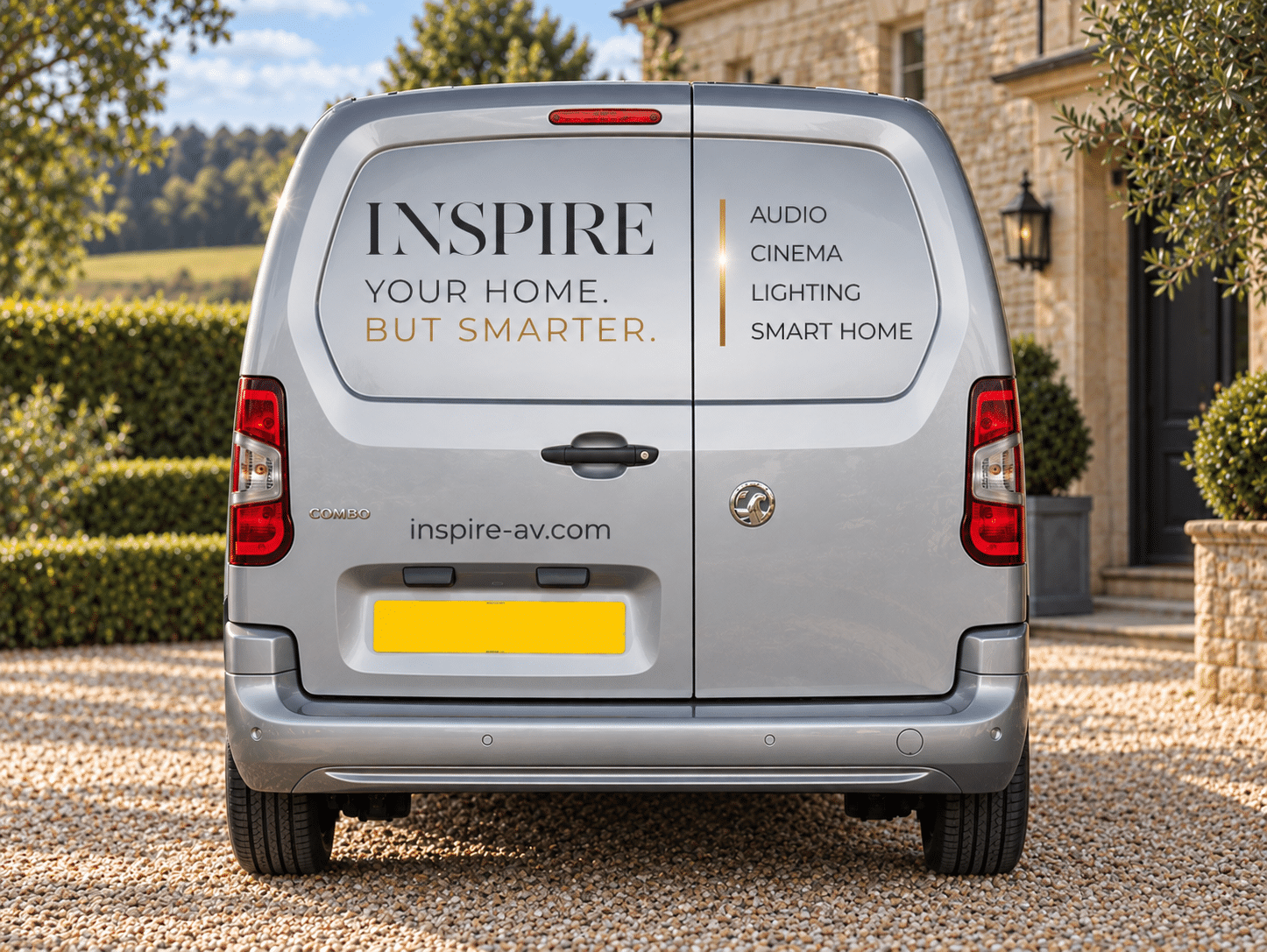
If you’re around Harrogate and North Yorkshire, you may start seeing the Inspire AV name on the road a little more often.

For years, most of our vans have actually been left unbranded — and there was a good reason for it.

In the earlier days of Inspire, our vehicles were fully branded. But as we started working on more high-end homes, including projects for some well-known clients, we were occasionally asked to arrive in unbranded vehicles.

For some clients, it was simply about privacy. For others, there were genuine security considerations, or they just preferred that the work happening inside their home remained exactly that — private.

And because Inspire has always been a client-first business, we listened.

Bringing the Inspire AV Brand Back to the Road

Fast-forward to today and, being completely honest, we want more people to know who Inspire AV is.

We’re designing and installing smart homes, home cinemas, lighting systems, networking and integrated technology across Harrogate, Yorkshire, Cheshire and London, and it makes sense for our brand to be visible while we’re out doing it.

But we didn’t want that to come at the expense of something our clients value.

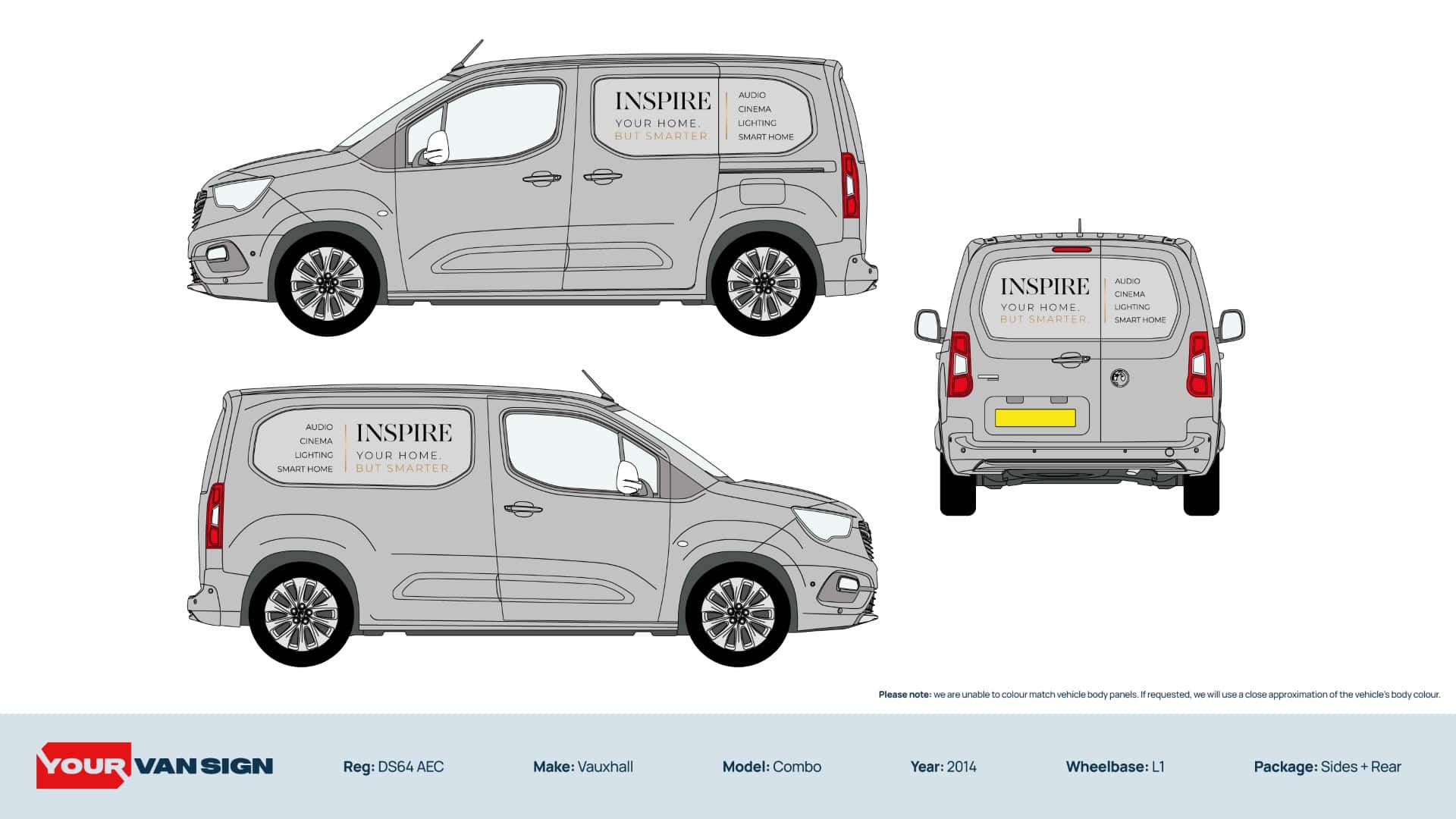
So rather than permanently wrapping the vans, we’ve had removable magnetic Inspire AV signage made.

Simple idea really.

When it’s appropriate, the branding is on.

When a client would prefer additional privacy or discretion, it comes off.

The same principle applies to our social media and project photography. We love showing the work we do, but ultimately the home belongs to the client, not our marketing department.

Smart Home Installation in Harrogate

Inspire AV has been designing and installing residential technology since 2009, working on everything from individual rooms through to complete smart home systems.

For homeowners, architects, interior designers and developers in Harrogate and the surrounding area, our work can include:

  • Control4 smart home automation

  • Intelligent lighting and lighting control

  • Home cinema and media rooms

  • Multi-room audio and television

  • High-performance home Wi-Fi and networking

  • CCTV, intercom and security integration

  • Automated blinds and curtains

  • Heating and climate control

  • Outdoor audio and entertainment

Our approach is to make technology feel like part of the home rather than something that has simply been added to it.

Good smart home design should make a house easier to live in, not more complicated.

So if you see one of the new Inspire AV vans around Harrogate, give us a wave.

And if you don’t see the branding one day, there might be a reason for that too.

Planning a smart home project in Harrogate or North Yorkshire?

Find out more about our smart home installation services in Harrogate or speak to the Inspire AV team about your project.

AI & Smart Lighting Control: Lutron, Control4 & Crestron

The Future of Smart Lighting Control: How AI Could Change Lutron, Control4 and Crestron Homes

Smart lighting control has transformed how we experience our homes. But could artificial intelligence take things a step further, making our lighting more intuitive, more efficient and more personal?

For nearly two decades, we've been designing and installing smart home systems at Inspire Audio Visual. During that time, lighting control has evolved considerably. We've moved from banks of conventional switches to beautifully designed keypads, automated scenes and systems capable of integrating lighting with blinds, heating, security and entertainment.

Yet fundamentally, most lighting systems still rely on one thing: somebody telling them what to do.

You press a button, select a scene or rely on a pre-programmed schedule. The system responds exactly as it has been instructed.

Artificial intelligence could change that relationship.

Instead of simply responding to commands, the next generation of smart lighting control might begin to understand how we live, predict what we need and adapt our surroundings without constant intervention.

But is that genuinely useful innovation, or are we in danger of making something simple unnecessarily complicated?

Smart Lighting Control Today: Already Pretty Clever

Modern lighting control systems from manufacturers such as Lutron, Control4 and Crestron are already remarkably capable.

We can programme a single keypad button to transform an entire living space. Lighting levels adjust, curtains close, music starts playing and a room changes from a practical family environment into somewhere designed for entertaining.

Astronomical time clocks can adjust exterior lighting around sunset and sunrise. Presence sensors can automate corridors and bathrooms. Scheduled scenes can gradually change lighting throughout the day.

In projects such as our York Penthouse Smart Lighting installation, the objective is to bring sophisticated technology into a carefully considered interior without making it complicated to use.

For homeowners, that simplicity matters far more than the technical complexity behind the scenes.

But even the best programmed lighting system has limitations.

A lighting designer or programmer makes decisions about how the home should behave based on what they know at the time of installation. As the homeowner's routines change, those decisions might need adjusting.

This is where AI becomes interesting.

What Could AI Actually Bring to Smart Lighting?

Imagine a home that understands the difference between somebody getting up early for work, a relaxed Sunday morning and an evening entertaining friends.

Rather than relying entirely on fixed schedules, an intelligent lighting system could learn patterns of behaviour and suggest or automatically make appropriate adjustments.

It might notice that the kitchen is normally occupied earlier during the week, that the family prefers warmer lighting in the evenings or that particular rooms are rarely used at certain times.

Combined with occupancy information, daylight levels and other sensors, AI could help the lighting respond more naturally to the way the property is actually being used.

Of course, much of this can already be achieved using conventional programming. The difference would be the system's ability to adapt rather than requiring an engineer to modify every rule.

The technology would also need sensible boundaries. A homeowner should always be able to override the automation, and the system must remain predictable.

Nobody wants their kitchen lights making unexpected decisions because an algorithm thinks it knows better.

The Real Opportunity: Better Lighting Design

For me, one of the most interesting applications of AI isn't necessarily how a finished smart home operates.

It's how we design it in the first place.

A properly considered lighting design involves far more than deciding where to put downlights.

We need to understand the architecture, natural daylight, furniture layouts, decorative fittings, colour temperatures, circuit arrangements and the way different spaces will be used.

Then there are the technical drawings, load schedules, dimming requirements, keypad locations, scene programming and coordination with electricians, architects and interior designers.

On a typical substantial residential project, we might spend around 60 hours on the design and associated planning work.

Could AI reduce that by 50%?

I think there's a realistic opportunity for it to do so in parts of the process.

AI-assisted software could potentially analyse architectural drawings, help identify circuit arrangements, produce draft schedules and accelerate repetitive documentation.

That could give designers more time to concentrate on the areas where their experience genuinely adds value.

But there's an important distinction between producing a lighting plan and designing beautiful lighting.

AI might identify where a fitting could go. It doesn't necessarily understand why a particular architectural feature deserves emphasis, how light will interact with a textured wall or the emotional effect of a carefully balanced scene.

Those decisions still benefit enormously from human experience.

Will AI Replace Lighting Designers and Programmers?

I don't believe so, although I do think the roles will change.

Much of what makes a successful lighting installation comes from understanding the homeowner rather than simply understanding the equipment.

A family with young children will use its home differently from a couple who regularly entertain. Somebody who works unusual hours might need very different lighting behaviour from someone following a conventional routine.

A well-designed system accounts for those differences.

Our job isn't to install as much technology as possible. It's to understand the people who will live with it and then use the technology appropriately.

AI could become an extremely powerful design assistant. It might make documentation faster, identify potential issues earlier and help us explore different approaches before installation begins.

But it shouldn't replace the conversations, judgement and experience that make a home feel right.

In many respects, I'd welcome technology that takes repetitive engineering administration away from our designers.

The more time we can spend thinking about the finished experience, the better.

What Does This Mean for Lutron, Control4 and Crestron?

Manufacturers such as Lutron, Control4 and Crestron have spent years developing reliable, sophisticated control platforms.

The interesting question is how AI might complement these systems.

I don't necessarily see the future as replacing established lighting control infrastructure with an entirely new generation of AI-powered devices.

A properly engineered lighting system still needs dependable dimming, suitable wiring, reliable communication and physical controls that work every time.

Instead, I suspect much of the intelligence could eventually sit above the existing infrastructure.

AI could potentially analyse how lighting scenes are used, recommend improvements, adapt schedules and help commissioning engineers refine system behaviour.

It might even allow homeowners to describe a desired atmosphere in natural language and have the system suggest an appropriate lighting scene.

That said, these are possibilities rather than features we can assume are currently available across the manufacturers' residential systems.

And reliability must remain the priority.

If your internet connection fails, you should still be able to turn your lights on.

The Homeowner Shouldn't Have to Think About the Technology

One concern I have with the smart home industry is our tendency to become fascinated by what technology can do rather than asking whether the homeowner needs it.

We've seen this with touchscreens, complicated interfaces and systems that offer hundreds of functions when most people only use a handful.

AI could easily become another example.

A homeowner doesn't necessarily want a conversation with their house every time they enter the kitchen.

They want the lighting to feel right.

Sometimes the most intelligent solution is still a beautifully designed keypad with three or four clearly labelled buttons.

The challenge for manufacturers and installers will be introducing greater intelligence without compromising the simplicity that makes a system enjoyable to live with.

In my view, the best smart home technology is the technology you barely notice.

Could AI Make Smart Lighting More Affordable?

If AI reduces the time required for some design, documentation and programming tasks, there could eventually be a financial benefit for homeowners.

On larger projects, engineering and design time represents a meaningful proportion of the overall cost.

Reducing repetitive work could improve efficiency and allow installers to spend more time refining the finished installation.

But that doesn't mean lighting design should become a fully automated, low-cost commodity.

A poorly designed lighting scheme doesn't become good simply because it was produced quickly.

The value comes from combining better tools with the experience to use them correctly.

For a professionally designed home, I'd rather see AI help us deliver a better outcome than simply make everything cheaper.

Our View: The Future Is Intelligent, but It Still Needs to Be Human

AI will almost certainly influence the way we design, programme and operate smart homes over the coming years.

Some of its most useful applications might be relatively unexciting from a consumer perspective: faster drawings, improved engineering coordination, more efficient commissioning and better analysis of how homes are actually used.

But those improvements could have a significant impact on the finished experience.

For homeowners, the objective should remain exactly the same as it is today.

Beautiful lighting, simple controls and a home that responds naturally to the people living in it.

At Inspire Audio Visual, we'll continue exploring new technologies as they emerge, but our approach won't change.

We start with the homeowner, the architecture and the way a space should feel.

Then we choose the technology that delivers it.

AI might change some of the tools we use along the way.

It shouldn't change that principle.

Planning a Smart Lighting Project?

Whether you're building a new home, renovating an existing property or considering an upgrade to an established lighting system, getting the design right from the beginning makes a significant difference.

At Inspire Audio Visual, we design and install intelligent lighting systems using Lutron, Control4 and Crestron, working alongside homeowners, architects and interior designers throughout Yorkshire, Cheshire and London.

Explore our lighting design and control services or contact our team to discuss your project.

Call Us

0330 4303490 or 0203 1515075

Email Us

inspireme@inspire-av.com

    Name (required)

    Email (required)

    Phone

    Area of interest

    Home CinemaSmart HomeLighting ControlAudio Visual

    Type of installation

    Price Margin (Leave blank or estimate if unsure)

    If you know the number of rooms within the property, please select from the options below.

    If you have any floor plans of the property you would like to submit, please attach below.

    This site is protected by reCAPTCHA and the Google
    Privacy Policy and Terms of Service apply.